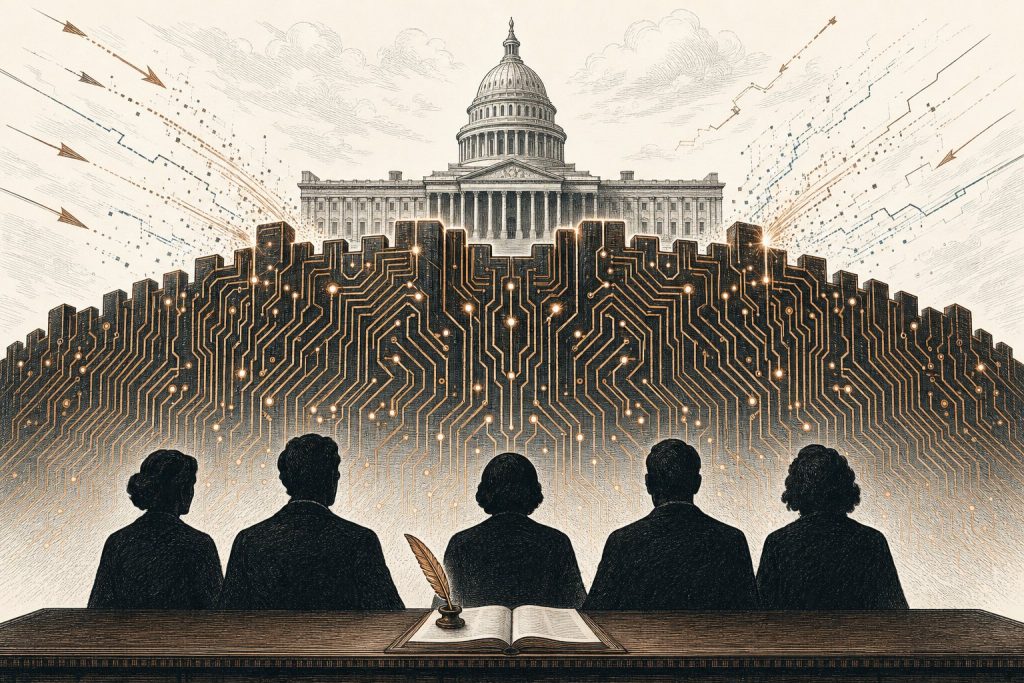
I watched the leaders of American technology—Sundar Pichai, Mark Zuckerberg, Dario Amodei, Greg Brockman, and Elon Musk—stand side-by-side with President Donald Trump at the White House to sign the White House Accord on Super Intelligence.
As someone who builds software, manages servers, and deploys AI tools daily, my immediate reaction was straightforward: optimism.
For the first time, we are seeing the federal government and American AI giants coordinate with real responsibility. They recognize that we are not in an academic seminar discussing theoretical risks; we are in a high-stakes, real-world race for technological supremacy against global adversaries—most notably China. The United States is finally organizing its digital defense wall.
The Press Conference Evidence
Below is the briefing footage where tech executives explain the accord, self-regulation, and the strategic urgency of American leadership:
The Regulation Trap: Why “Miss Honest” Loses the War
Whenever AI safety enters the news cycle, the default reaction from critics is to demand heavy, immediate federal restrictions. But sitting in the trenches of engineering gives you a very different perspective on what unilateral regulation actually does.
If the entire world played by the same rules—if foreign adversaries and companies like Alibaba held themselves to strict ethical protocols—I would welcome tight legislation tomorrow. But that is not the world we live in.
It is completely naive to demand that American companies play the role of “Mr. or Miss Honest,” tied down by bureaucratic red tape and rigid legal brackets, while foreign adversaries cheat, scrape, and launch AI-assisted cyber operations without restraint. That is unilateral digital disarmament.
In my day-to-day work maintaining server infrastructure and managing web deployments, the threat is not abstract. I see the malicious traffic. I have tracked aggressive, automated attacks hitting American infrastructure directly from foreign IP ranges—including IPs originating from Chinese providers like Alibaba Cloud. When you submit abuse reports and demand accountability, what happens? Total silence, outright denial, and zero cooperation. They have no interest in helping us secure the web.
American businesses—from sole proprietorships and local enterprises to major institutions—are targeted every single hour. To defend them, we need aggressive, fast-moving, world-class American AI companies acting as our shield.
Does voluntary self-policing sound imperfect? Perhaps. But within American tech culture, we have something foreign authoritarian systems don’t have: aggressive peer scrutiny and a fierce whistleblower culture. When something goes wrong inside an American lab, engineers speak out, whistleblowers blow the whistle, or people resign and sound the alarm. Combined with four-layer audits and independent board oversight, that peer ecosystem gives us the speed to compete without suffocating the engine that keeps us safe.
Beyond Politics: It Really Is “Super Intelligence”
I will be very honest: I disagree with President Trump on many political issues. But on this specific point, I agree with him completely, and I admire his enthusiasm in pushing American tech forward.
Trump called for dropping the term “Artificial Intelligence” in favor of Super Intelligence (SI). He is right.
“Artificial” feels dated. It evokes plastic imitations or mechanical toys. What we are dealing with right now is anything but imitation. I have been building with these models since the third week ChatGPT went public. Every single week since, I have watched the reasoning expand, the code generation sharpen, and the capabilities jump into territory we never experienced before.
It is shockingly capable. Calling it Super Intelligence is not political theatre—it is an accurate technical recognition of the new era we have entered.
Abundance vs. Human Nature: A Dose of Engineering Reality
During the briefing, Elon Musk painted a utopian vision of this future, predicting that Super Intelligence and humanoid robotics will transcend Universal Basic Income (UBI) and deliver “universal high income,” solving all human labor and providing luxury healthcare for everyone.
I wish we could build such an ideal world. But as someone grounded in real-world systems, I don’t buy it.
The idea that AI will simply eliminate work and give everyone a check ignores two fundamental truths:
- The Law of Expanding Problems: Every time technology solves one problem, ten new problems emerge in its place. Even if Super Intelligence solves biological disease or logistics, we will immediately face the challenge of managing SI itself, exploring deep space, securing planetary energy, and re-architecting cybersecurity. There will always be complex, demanding work to be done.
- Human Nature and Accountability: Our society does not function on giving the same reward to someone who builds and stays up late solving problems as someone who produces nothing. Look around us right now—we have immense wealth and technology in California, yet homelessness remains unsolved. Human societies inherently reward effort and discipline.
There won’t be an idle utopian paradise where human effort is obsolete. There will be new challenges, new frontlines, and new demands for hard-working people who know how to command these tools.
A Ground for American Optimism
If you are an American business owner, an engineer, or a citizen wondering what this White House summit means, you should feel optimistic.
We are living in an era of deep global uncertainty. No one can predict every twist of this technological shift. But seeing our government sit down with the architects of modern computing—not to strangle them with arbitrary rules, but to challenge them to build safely, audit rigorously, and lead aggressively—is the exact right step.
The race is on. The line has been drawn. And the United States is standing up to win it.