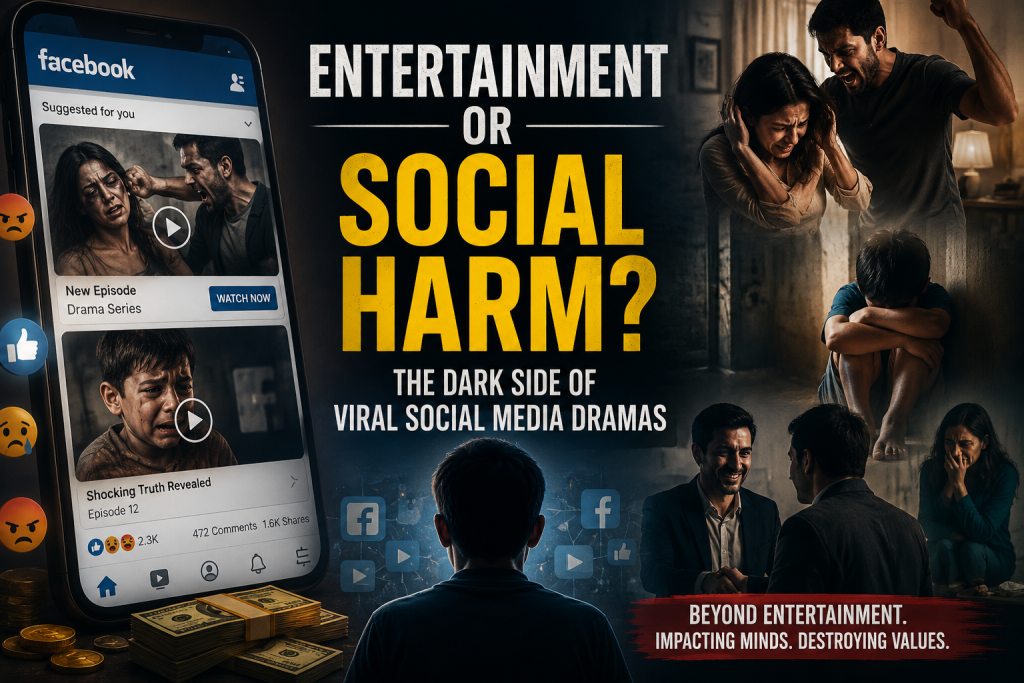
Over the past few months, a new style of short drama has spread very fast across Facebook and other social media platforms. These videos are designed to catch our attention immediately, keep us engaged, and make us watch episode after episode. Their popularity is clear. But after watching several of them, I started asking a troubling question: What kind of behavior are we promoting, and what is the real cost?
Shock Value Instead of Real Art
Many of these videos seem to be made for American audiences, but they do not reflect the real culture or values that I know. Instead, they present a world full of betrayal, abuse, violence, and family conflict. Husbands hit their wives. Children are treated badly. Friends cheat one another. Almost every episode is built around cruelty or manipulation.
The issue is not that they show difficult subjects. Serious topics have always been a part of books, theater, and movies. The real problem is how they show these topics.
Professional filmmakers understand that storytelling is an art. Even when they show violence, they use symbols, suggestions, and good direction. A powerful performance can show suffering without making it look cheap or exploitative. Good storytelling respects both the audience and the subject.
Many of these social media dramas do the opposite. They do not use artistic restraint; instead, they rely entirely on shock value. They do not build deep characters; they just focus on extreme situations to get an immediate emotional reaction. Furthermore, many of the performers do not look like professionally trained actors. Because of this, the stories feel less like carefully crafted dramas and more like sensationalized reenactments made only to get clicks.
How the Videos Control Our Attention
The psychology behind this trend is very powerful. The scripts are written to trap the viewer’s attention instantly.
- Constant Suspense: Every scene ends with a cliffhanger (a sudden stop that leaves you wanting to know what happens next).
- Exaggerated Problems: Every argument is made to look much bigger and more dramatic than real life.
- Targeting the Youth: These techniques are highly effective, especially among younger audiences who spend a lot of time online.
This raises an important question: Are these videos created to tell meaningful stories, or are they simply engineered to maximize views and advertising money?
In my view, the answer is clear. Much of this content is made just to generate profit. Social media algorithms reward attention, and the easiest way to get attention is through anger, fear, conflict, and shock. This creates a bad cycle: creators make crazier and more negative videos because that is what the platforms promote.
The Involuntary Audience
What is even more concerning is that viewers do not always look for these videos. Social media algorithms put them directly in front of us through recommendations and advertisements. In many cases, people encounter them simply by scrolling through their daily feeds.
A Note on Freedom of Expression: Freedom of speech is an essential value, and we should not censor creative works just because they talk about hard topics. However, society also has a responsibility to discuss the impact of content that is specifically designed to exploit human psychology for money.
Conclusion: Is the Profit Worth the Cost?
As these short dramas continue to spread, social media companies, parents, teachers, and policymakers need to pay closer attention to their influence. Entertainment shapes our culture. It changes how people view relationships, family, trust, and community.
When the most successful videos consistently promote conflict, abuse, and manipulation, we must ask a critical question: Has the pursuit of engagement become more important than the responsibility of reaching millions of viewers?
This conversation is not about banning stories. It is about asking whether every click, every view, and every dollar earned is worth the social harm.