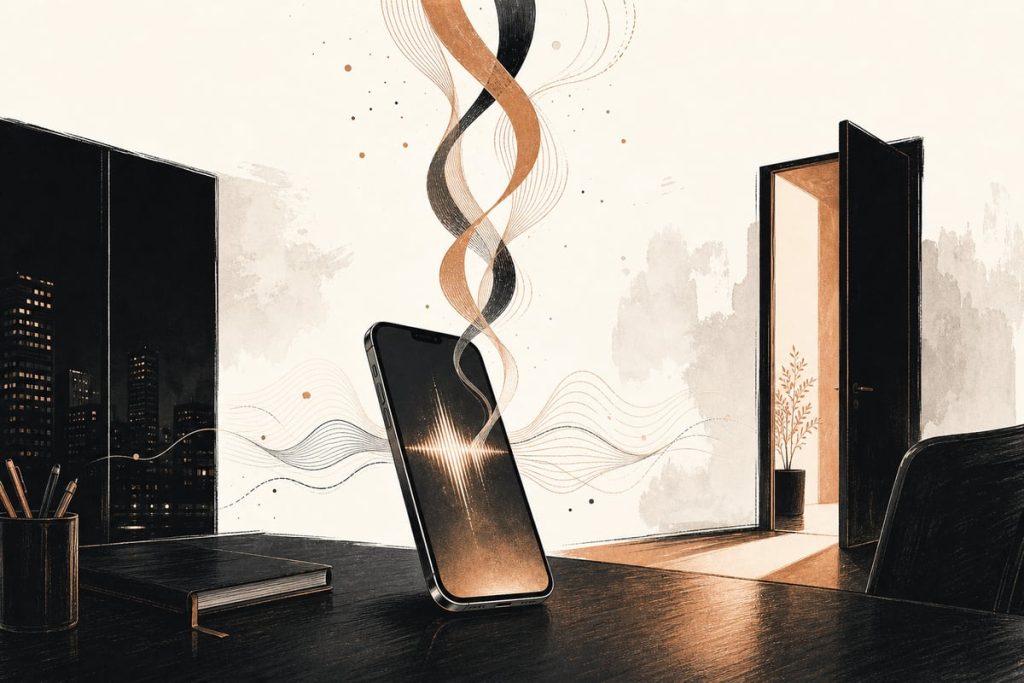
There is a particular silence that small business owners know well. It is the silence of a phone ringing in an empty office at 7:40 in the evening, long after the lights are off — a call from someone who needed an answer badly enough to try after hours, and who will not call twice. In that silence a livelihood quietly leaks away, one unreturned call at a time.
I have been thinking about that silence for a while now, and recently I did something about it: I built an AI receptionist. It answers the phone in English and in Spanish, takes down what the caller needs, and emails the owner a clean summary before the caller has even hung up. I called it TelAI. But this essay is not really an advertisement for a piece of software. It is about what I learned when I tried to teach a machine to do something as human as answering the phone.
The phone is the front door
We talk endlessly about websites and apps, but for a vast number of small businesses — the immigration lawyer, the dentist, the roofer, the family clinic — the telephone is still the front door. It is where trust begins. And for roughly two-thirds of every week, that door is locked: evenings, weekends, lunch hours, the long stretch when the one person who answers the phone is already on another line.
The people most often shut out by that locked door are the ones with the least slack in their lives. They call after a shift. They call from a shared family phone. Many of them are more comfortable explaining a problem in Spanish before they switch to English. When they reach a voicemail box, most of them simply do not leave a message. They call the next name on the list. The business never learns it lost them.
Teaching a machine to listen
The engineering problem, it turned out, was not the talking. Machines have become eerily good at talking. The hard part was listening — and knowing the limits of what it had heard.
A receptionist’s real skill is not eloquence; it is restraint. It is knowing which questions to ask, when to stop, and — crucially — when to say “I can’t answer that, but I’ll have someone who can call you back.” The most important rule I wrote into the system was not a feature but a refusal: it never pretends to give legal or medical advice, in any language. It takes the message. It tells the truth about being a machine. It hands the human back to a human.
I found something quietly moving in that constraint. We tend to imagine artificial intelligence as a force that wants to replace us. The version I found useful was the opposite: a tool whose entire job is to hold a door open until a person can walk through it. It does not close the deal. It refuses to lose the caller.
Language as hospitality
The part I cared about most was the bilingual switch. In Los Angeles, a caller will begin a sentence in English and finish it in Spanish without noticing they have done so, the way my own family slides between English and Arabic at the dinner table. To most automated phone systems, that switch is an error to be handled. I wanted it to be the opposite — a small act of hospitality, a way of telling the caller: you do not have to translate yourself to be taken seriously here.
That, more than any technical benchmark, is the thing I think we get wrong about this technology. We measure it by what it can produce. We should measure it by who it lets in. A machine that answers in your language at the hour you are free is not, in the end, a story about automation. It is a story about access — about whether the people on the margins of the workday get a call returned at all.
The honest limits
I will not pretend the machine is a person, and neither does it. It does not offer comfort; it offers a returned call, which on a bad night is its own small mercy. It can mishear a name. It needs a human watching the transcripts, especially in the first weeks, the way you would train any new hire. And there are conversations — grief, fear, the genuinely complicated — that no software should be the first to hold. The goal was never to remove the human from the loop. It was to make sure the loop never breaks at 7:40 in the evening.
What I keep returning to is that old silence, and how strange it is that we accepted it for so long as simply the cost of being small. A missed call was treated as weather — unfortunate, inevitable. It is not inevitable anymore. We can, modestly and carefully, keep the door open.
I am an engineer, and I built a tool. But I am also, stubbornly, someone who believes the measure of a technology is whether it returns a little dignity to ordinary life. A returned phone call is a small thing. So is a held door. Civilizations, it turns out, are largely made of small things done reliably, in the language of the person standing in front of you.